JavaFlowStudio
🌀 JavaFlow Visual Studio
A premium, agentic, non-blocking visual orchestrator designed to compose, compile, test, and package Spring WebFlux Java Microservices in real-time. Inspired by n8n and built on top of React Flow and Spring Boot, it bridges visual flow architectures directly to native Java structures.
⚡ Core Highlights
- 🎨 Visual Microservice Composition: Drag, connect, and customize WebFlux controllers, handlers, facades, services, repositories, and entities.
- 📦 Dynamic Java Project Exporter: Generates complete Java maven packages directly onto the host filesystem, complete with
pom.xml,application.yml, and clean, ready-to-run code. - 🔄 Host Maven Dependency Caching: Integrates host volume mounts to sync and pre-download jar dependencies directly to
~/.m2using containerized Maven offline tasks. - 🚀 Live Integration Test Runner: Connects to external APIs (using reactive
WebClient) and runs full integration sequences in memory, outputting step-by-step console logs. - 📂 Portability: Import and export workflow configurations as standard JSON schema files.
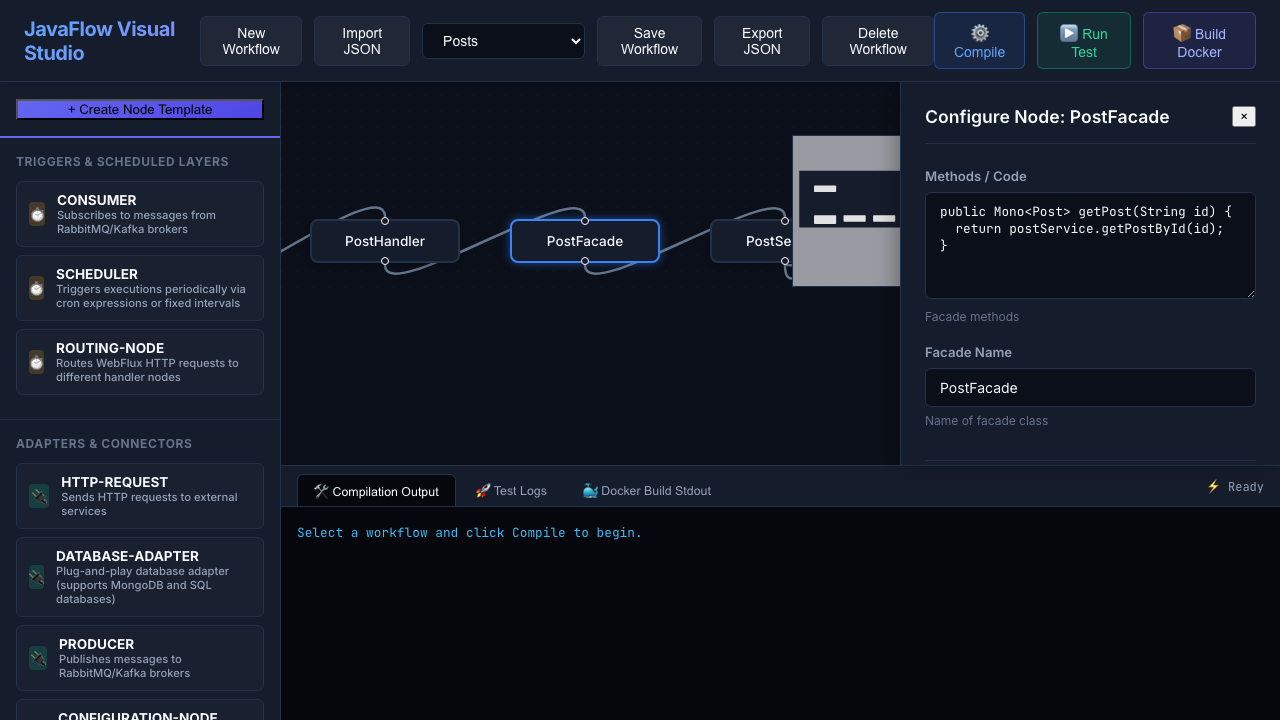
📸 Seeded Ingestion Workflow: “Posts” CRUD Pipeline
We have seeded a complete end-to-end GET /api/posts/{id} data ingestion workflow. Below is a detailed walkthrough of each architectural node layer and its parameters:
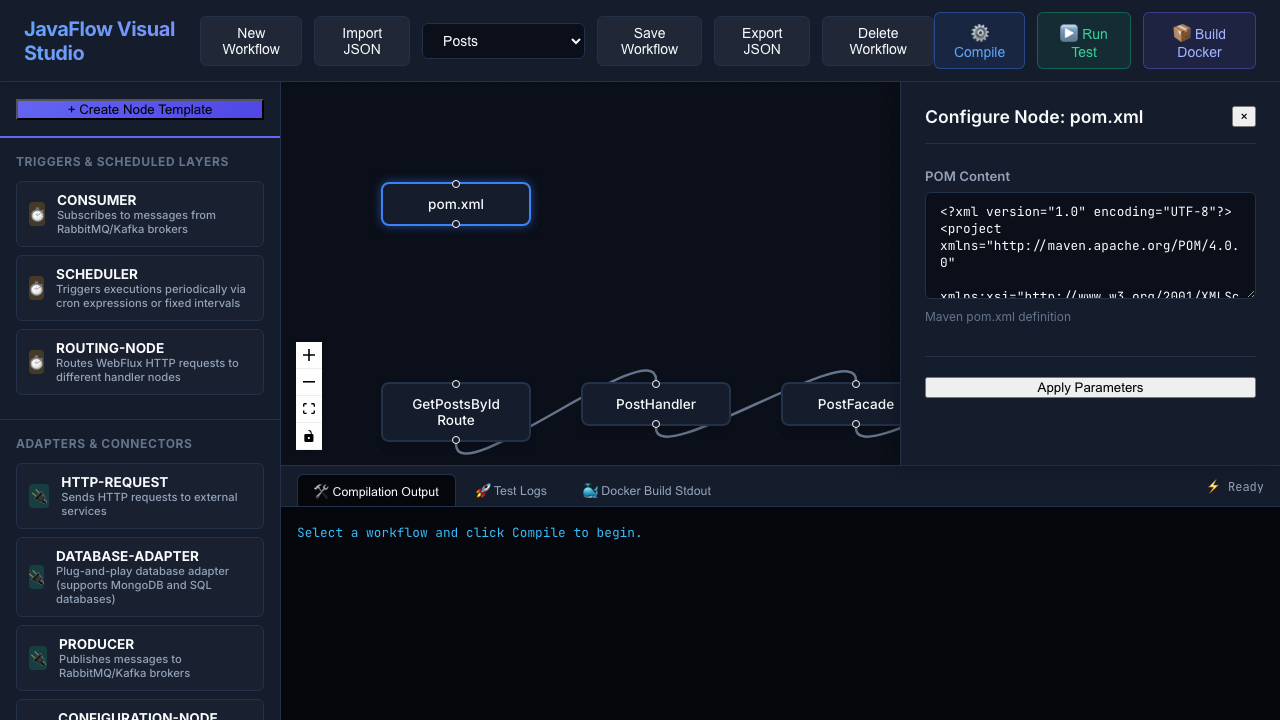
1. Maven Project Configuration (pom.xml)
Defines the Spring Boot starter parent and registers reactive dependencies (WebFlux, Lombok, MongoDB).
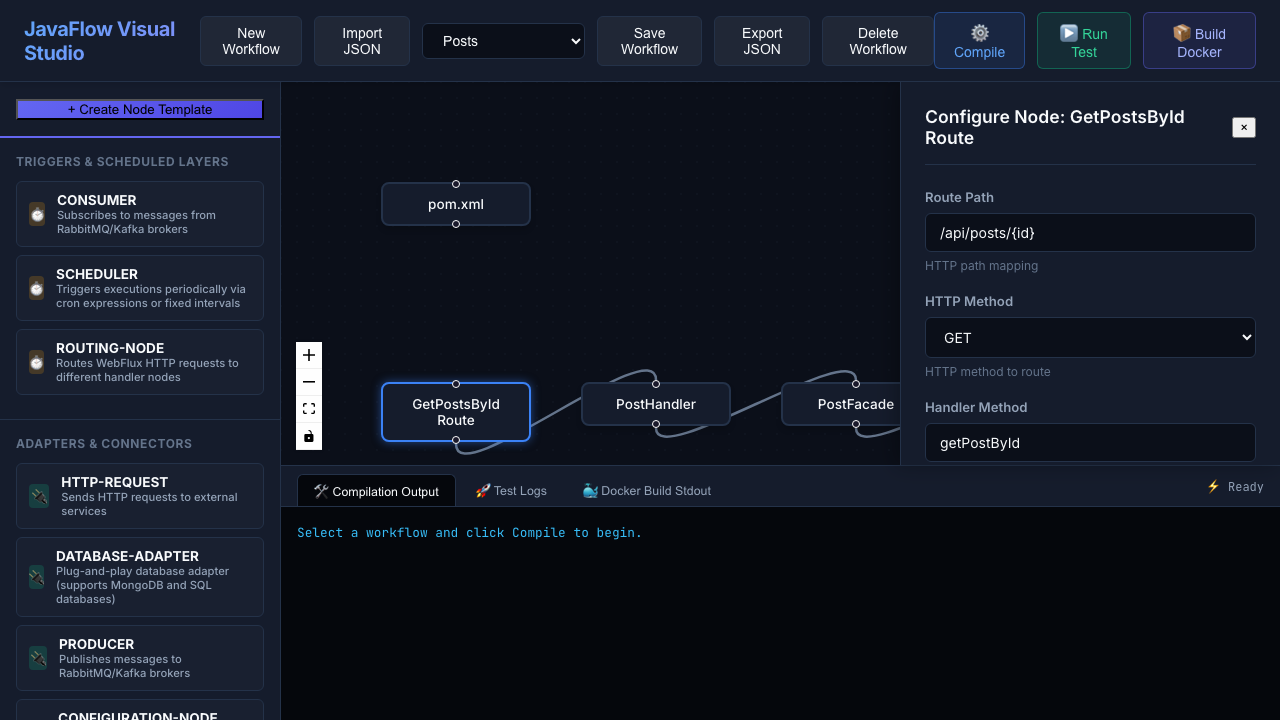
2. Router Layer (GetPostsById Route)
Specifies the HTTP path /api/posts/{id} and maps the GET operation to the PostHandler.
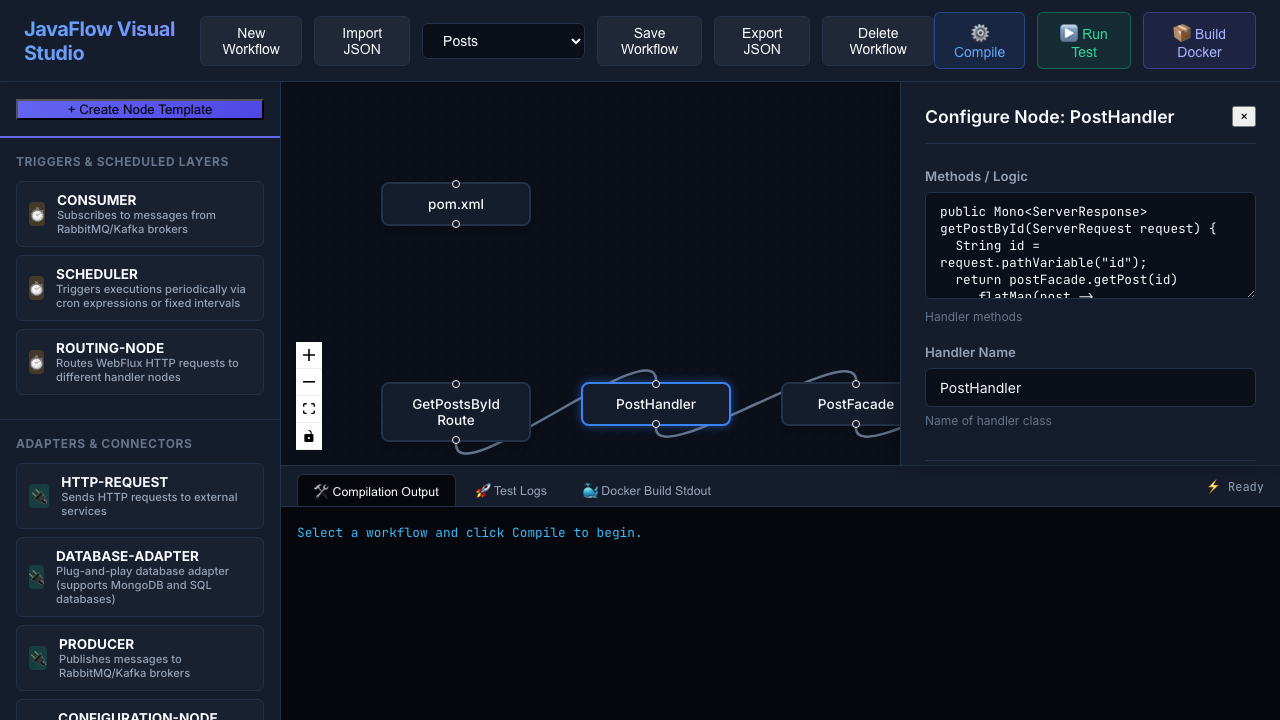
3. Handler Layer (PostHandler)
Extracts the route path variables and passes the incoming payload down to the Facade component.
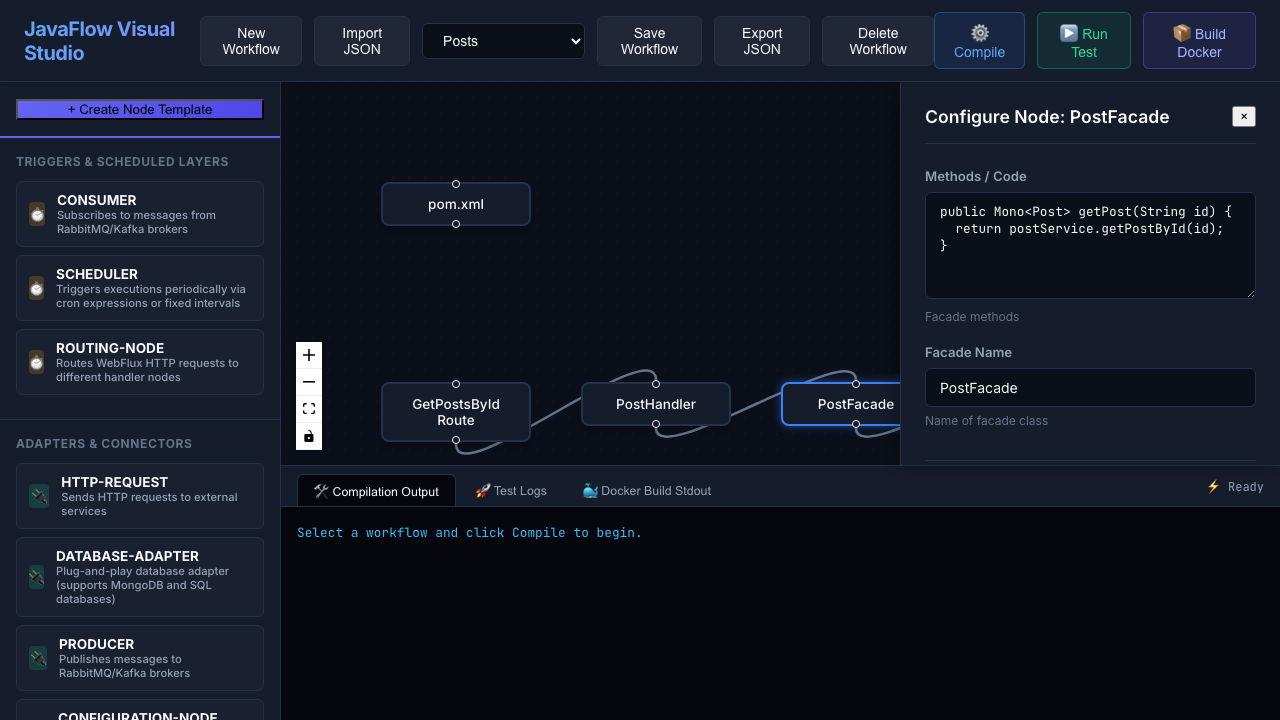
4. Facade Layer (PostFacade)
Decouples request/response formatting from business logic by delegating variables to the service.
5. Service Layer (PostService)
Executes the business logic, logs debug traces, triggers the HTTP client, and saves the entity to MongoDB.
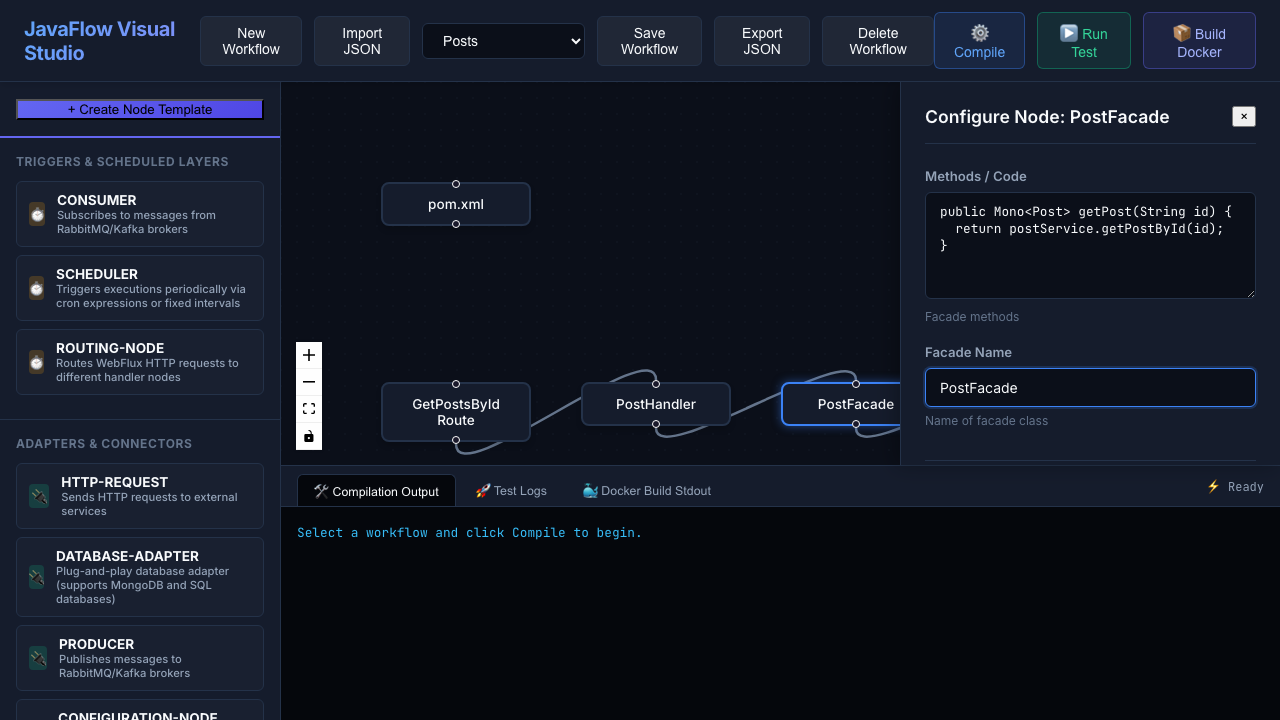
6. WebClient Layer (PostWebClient)
Executes a live non-blocking HTTP GET call to retrieve the requested post resource.
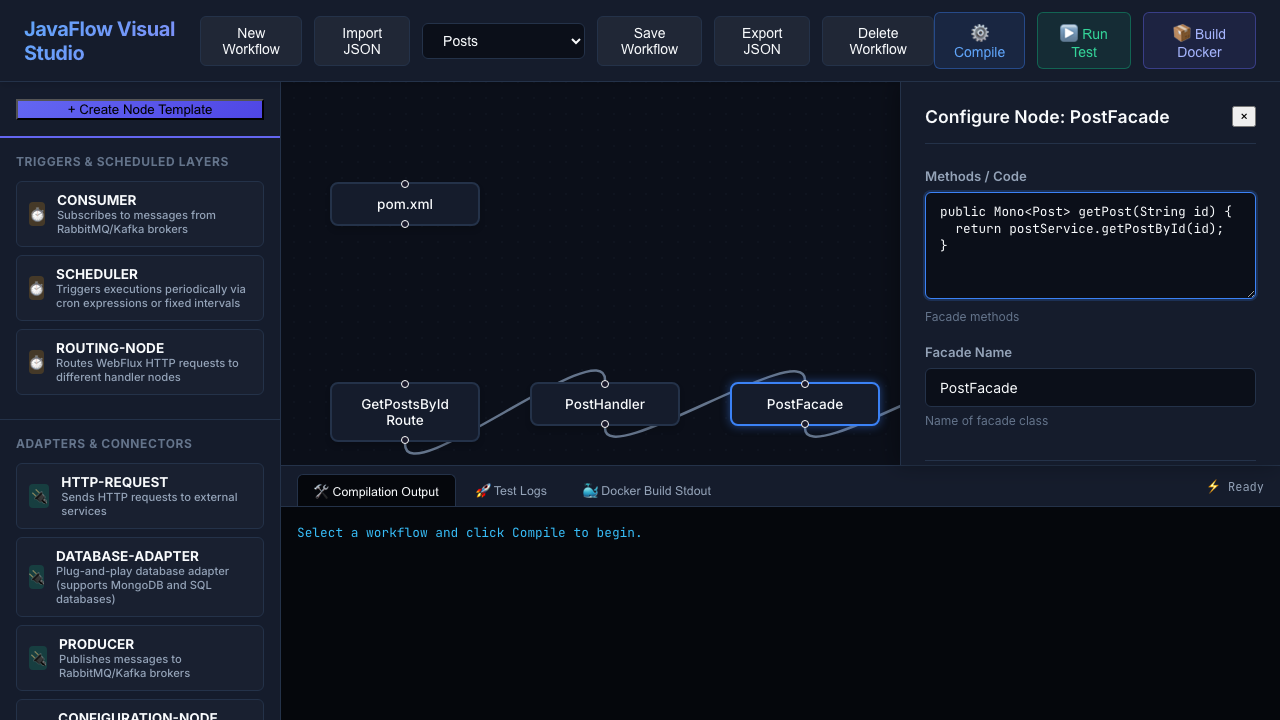
7. Entity Layer (Post)
Defines the POJO structure with Lombok annotations (@Data, @Builder, @NoArgsConstructor, @AllArgsConstructor) and maps to the target MongoDB collection.
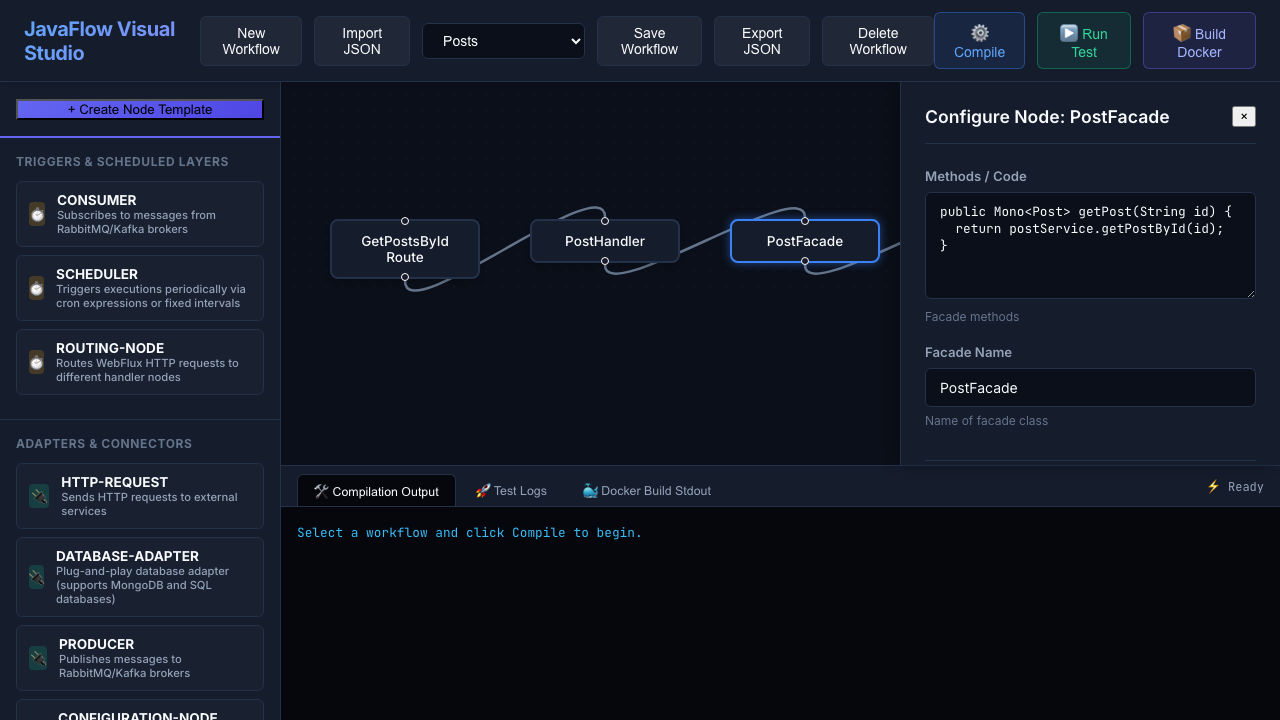
8. Repository Layer (PostRepository)
Extends the Spring Data ReactiveMongoRepository interface to provide built-in CRUD operations.
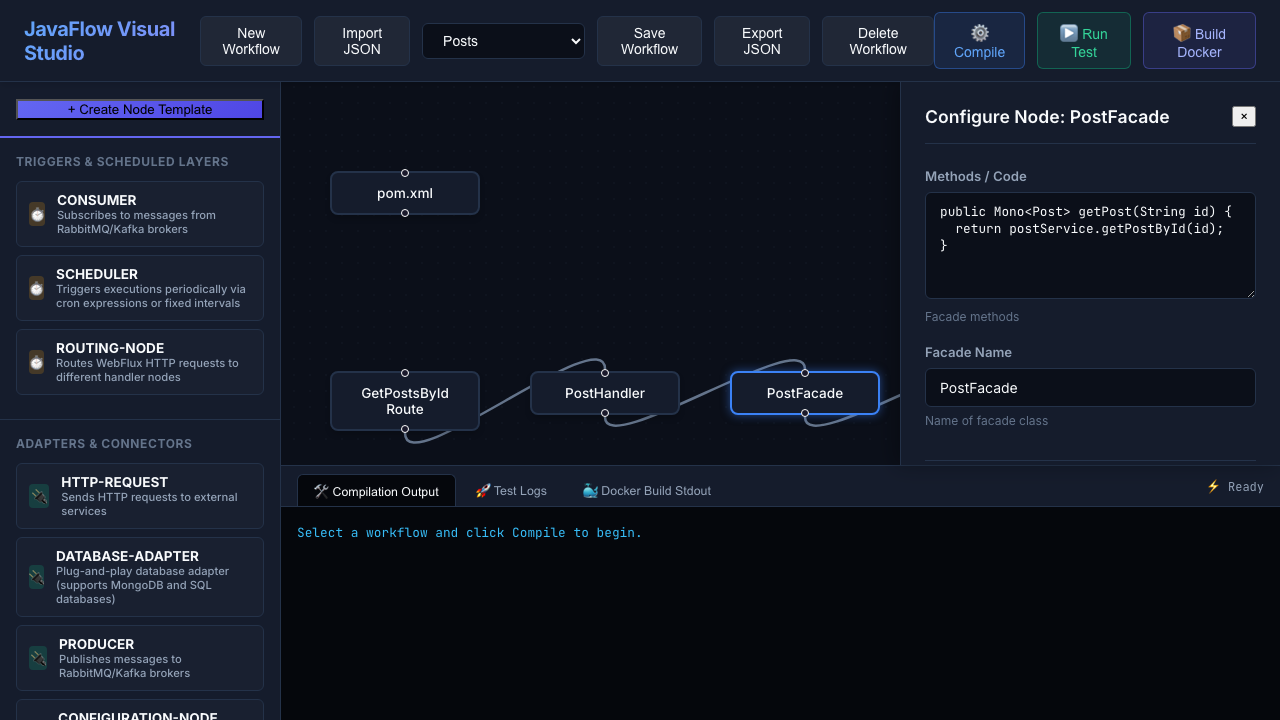
9. Database Adapter (Admin DB Adapter)
Holds the database credentials and coordinates connectivity to MongoDB.
🏗️ Quick Start
Prerequisites
- Docker & Docker Compose
- Java 17+ & Node.js 18+ (if running bare-metal)
Running with Docker (Recommended)
Launch the complete stack (MongoDB, Backend Spring WebFlux, Frontend Visual Editor):
docker-compose up --build
Access the services at:
- Visual Studio Frontend: http://localhost:3000
- Backend API: http://localhost:8080/api
- Dynamic API Docs: http://localhost:8080/webjars/swagger-ui/index.html
📖 Developer Documentation
For details on standard configuration schemas, extending node types, and system architecture, check out the Developer Documentation.
🤝 Credits & Collaborations
- JSONPlaceholder: Special thanks to JSONPlaceholder for supplying the mock REST API backend used to test the reactive HTTP WebClient integration pipeline.
- Antigravity 2.0: Developed in collaboration with the Antigravity 2.0 AI pair programming agent by Google DeepMind.